How is Modern Education Redefining Learning Beyond Textbooks?
posted on Jul 22, 2026
Modern education is no longer dependent on textbooks alone to deliver a meaningful learning experience.
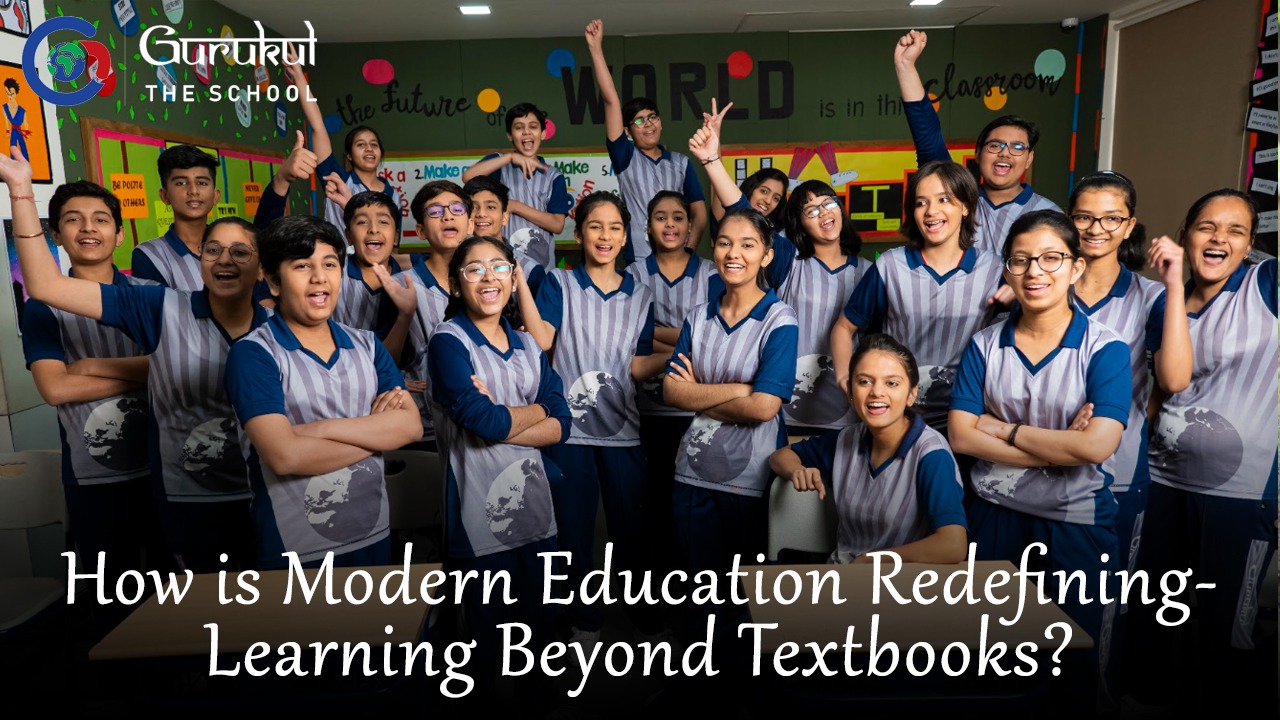
Textbooks have remained the backbone of school education for as long as one can remember. And why not? They introduce learners to concepts and provide them with a structured path for learning. While they’re still important, modern education is no longer dependent on textbooks alone to deliver a meaningful learning experience.
Today, the top schools in Ghaziabad, including us at Gurukul The School, have embraced a broader learning approach in which both textbooks and hands-on activities make equal contributions to shaping children’s learning experiences.
Having said that, we very well understand that if you’re accustomed to the old ways of learning, this change can be difficult to understand. Hence, we’ve created this blog post to help you understand how modern education is redefining learning beyond textbooks. As a parent, you can use this information to realign your expectations and better support your child’s learning journey. So, let’s begin by exploring the following points.
- Prioritising Understanding and Application Over Memorisation
Modern education is making students realise that true knowledge cannot be memorised; it can only be understood and retained. While students still need textbooks to create a strong academic foundation, their learning doesn’t end with completing a chapter or remembering definitions.
Instead, in the modern world, students are encouraged to apply concepts through experiments, case studies, projects, simulations, and other practical activities that involve real-world problem-solving. Textbooks now act as the starting point of learning, and practical hands-on activities bring them closer to conceptual understanding and application, concluding the learning on a stronger note.
- Encourages Students to Connect Ideas Across Subjects
Real life works in a lot different manner than how it appears in textbooks. What we mean to say here is that once children move beyond the borders of their school, they’ll rarely come across a problem that fits into a single subject. For example, whether they try to understand economic inequality or design a sustainable city plan, they’ll require knowledge from across subjects.
It’s a key reason why we at Gurukul The School teach our students using an interdisciplinary approach. So, even when we use textbooks for teaching, we don’t treat each subject as an isolated source of knowledge. The modern education principles followed in our school encourage students to recognise connections between subjects so that they can understand how each subject relates to others. This helps children develop a broader perspective. It helps strengthen their analytical thinking, enabling them to understand how different disciplines work together to solve complex, real-world challenges.
- Transforms Students from Passive Learners to Active Thinkers
Traditional education was focused more on obtaining information, and this is the key reason that students, back then, resorted to rote memorisation. However, the rules have changed in the modern education landscape.
Under the new approach, learning isn’t limited to textbooks. It encourages students to question, investigate, discuss, and reflect. Even teachers have taken up a new role to facilitate modern education. They’ve now become facilitators, helping students explore ideas and evaluate evidence. They use a healthy mix of classroom discussions, research activities, debates, or inquiry-based projects to help children learn better.
This shift develops in students the curiosity, intellectual confidence, and the ability to think critically rather than accepting information at face value.
- Uses Technology to Expand Learning, Not Replace It
The role of technology in modern education extends far beyond replacing printed books with digital screens. Once students learn from textbooks, they participate in several hands-on activities, such as interactive simulations, to develop conceptual understanding and clarity.
Modern education creates ample opportunities for students to develop these competencies through presentations, team projects, competitions, collaborative classroom activities, etc.
At Gurukul The School, we use Project-Based Learning (PBL) activities that are rooted in our ACT vision: A = Awareness, C = Communication, and T = Technology. We also use age-appropriate digital tools responsibly to facilitate modern learning experiences.
Frequently Asked Questions (FAQs)
- Does learning beyond textbooks mean textbooks are becoming obsolete?
No, textbooks are a crucial part of modern education as well. They act as the starting point of learning, so they’ll never become obsolete.
- How is modern education redefining learning beyond textbooks?
Modern education doesn’t rely on textbooks or other passive learning methods alone. It encourages students to participate in project-based and inquiry-driven learning activities for more meaningful learning experiences.
- Is interdisciplinary learning a part of modern education?
Yes, most schools delivering modern education follow an interdisciplinary learning method. It helps students connect concepts across different subjects.
- How can parents identify a school that promotes learning beyond textbooks?
A school that promotes learning beyond textbooks will integrate project work, inquiry-based learning, and collaborative learning opportunities into everyday learning.
Conclusion
Textbooks were always an indispensable part of education, and they still are. However, modern education is redefining learning experiences by going beyond textbooks. Modern schools like Gurukul The School recognise that textbook knowledge alone does not prepare children for the opportunities and challenges of today’s world. By combining strong academic foundations with practical application, interdisciplinary learning, critical inquiry, etc., we at our school are leaving no stone unturned in redefining what it truly means to learn.
If you’re looking for a reliable learning partner that delivers modern education through a combination of textbooks and hands-on activities, then enrol your kids in Gurukul The School, trusted as the top school in Ghaziabad.